
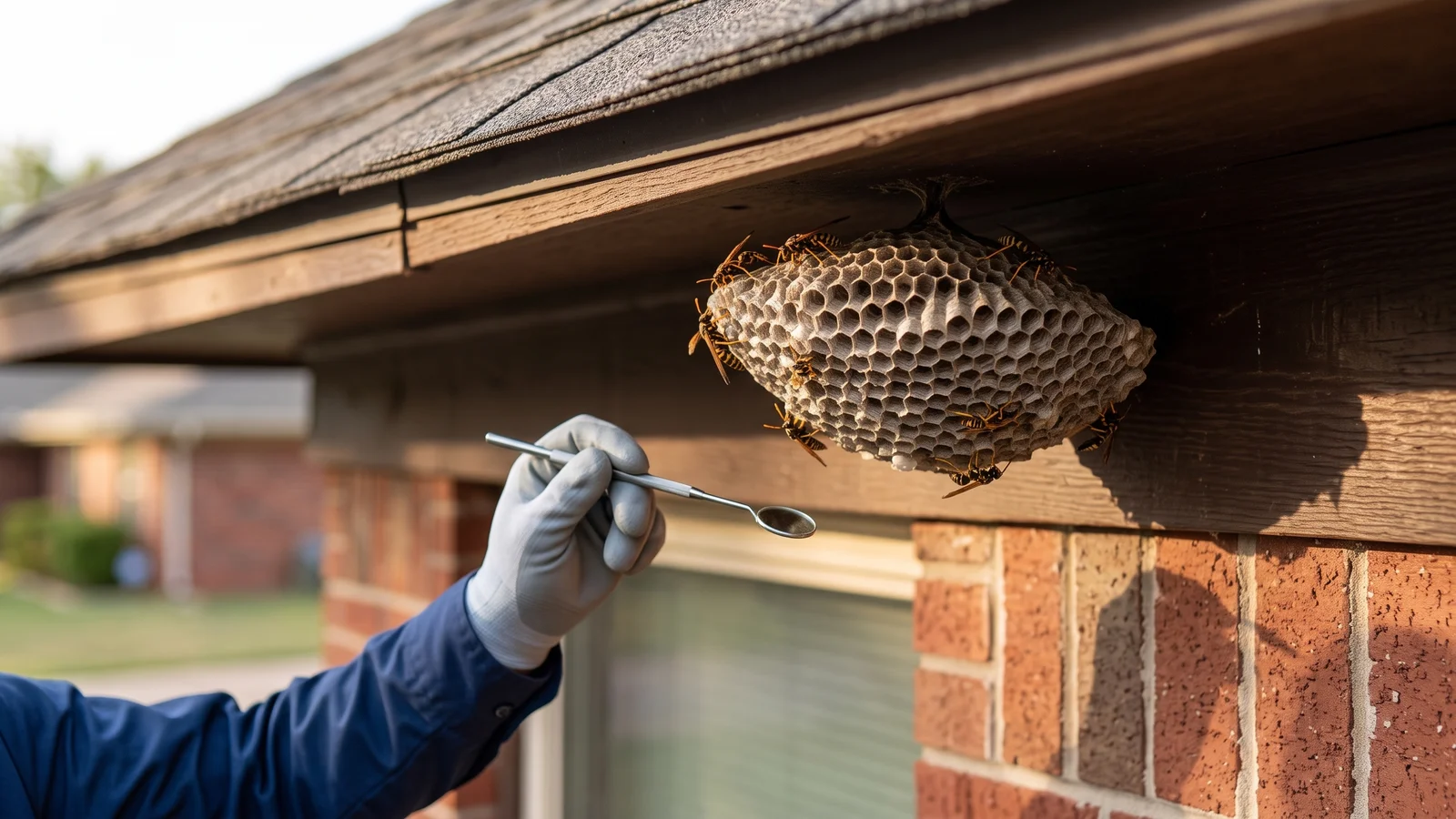
Paper Wasp
Slender, long-legged, with an open umbrella-shaped nest.
Pest ID Guide
A nest under the eaves or a hole full of yellowjackets calls for care. This guide helps Oklahoma City homeowners tell paper wasps, yellowjackets, and hornets apart by their nests and behavior, so you know the risk.
If you spotted a nest near a door or a swarm of yellow and black insects in the yard, you are dealing with wasps. This guide is for Oklahoma City homeowners who want to know the type, since some sting far more readily than others.
Wasps are slender, smooth, and narrow-waisted, unlike fuzzy bees. In Oklahoma the three you meet most are the paper wasp, the yellowjacket, and the bald-faced hornet. The nest often names the wasp faster than the insect itself.
The type matters for your safety. Paper wasps are calmer than yellowjackets, which defend ground nests aggressively. Knowing what you have helps you decide whether to keep your distance and call a pro.
Read the wasp and its nest together.
Slender, long-legged, with an open umbrella-shaped nest.
Short and stocky, black and yellow, nests in the ground.
Large and black with a white face, builds gray paper globes.
Paper wasp combs hang open under eaves and rails.
Yellowjackets nest in soil, wall voids, and old burrows.
Hornets build large, football-shaped hanging nests.
Watch nests, traffic, and behavior around the home.
Nests under eaves, rails, or hanging from branches.
Wasps flying in and out of a single hole in the yard.
Steady wasp traffic at a gap in siding or soffit.
Wasps swarming out when you pass near a nest.
Yellowjackets crowding trash and food in late summer.
Multiple stings signal a defended nest close by.
Note whether it is open, enclosed, or in the ground.
See how quickly the wasps react to your approach.
Do not disturb a ground or enclosed nest.
Book removal for nests near doors or high traffic.
Paper wasps are relatively calm and will usually leave you alone unless their open, umbrella-shaped nest is threatened. They still sting, so a nest by a door or window is worth removing, but they are the least aggressive of the three.
Yellowjackets are a different story. They nest in the ground or in wall voids, defend those nests fiercely, and can sting many times. In late summer they also scavenge food and crowd trash and picnics, which puts people close to danger.
Bald-faced hornets build large enclosed paper nests and defend them aggressively. Because wasps and hornets can sting repeatedly, and stings are dangerous to allergic people, active nests near living space are best handled by a professional.
He did an extra treatment on the first visit and came back after two weeks. The problem was gone in both houses. Very trustworthy.
We had a huge yellowjacket nest by the back door. They handled it fast and safely with the kids around. Very grateful.
Could not have had a better experience. They explained the plan, came out fast, and I saw results the first week. Highly recommend Armory.
Get a free inspection from a veteran-owned team. We identify the wasp, remove the nest safely, and help prevent the next one across the Oklahoma City metro.