
Large Body
Bodies up to nine inches, far bigger than a mouse.
Pest ID Guide
Heavy scurrying, large droppings, or gnawed wood often mean rats, not mice. This guide helps Oklahoma City homeowners confirm rats by their size, burrows, and grease trails, and understand why they need fast action.
If the droppings you found look large and the noises in the walls sound heavy, you may have rats rather than mice. This guide is for Oklahoma City homeowners who need to tell them apart, since rats cause more damage and carry serious health risks.
The two common rats are the roof rat and the Norway rat. Both are much larger than a mouse, with bodies up to nine inches plus a long tail. Norway rats are heavy-bodied with blunt snouts and burrow in the ground, while roof rats are sleeker and climb.
Size is the fastest clue. If a rodent looks stocky and its droppings are the size of a raisin, you are dealing with rats. That distinction changes the tools, the timing, and the urgency of the fix.
How to recognize rats and separate them from mice.
Bodies up to nine inches, far bigger than a mouse.
Norway rats have heavy bodies and blunt faces.
A thick, scaly tail, shorter than the body on Norway rats.
Large droppings, about three quarters of an inch long.
Roof rats are sleek climbers found in attics and rafters.
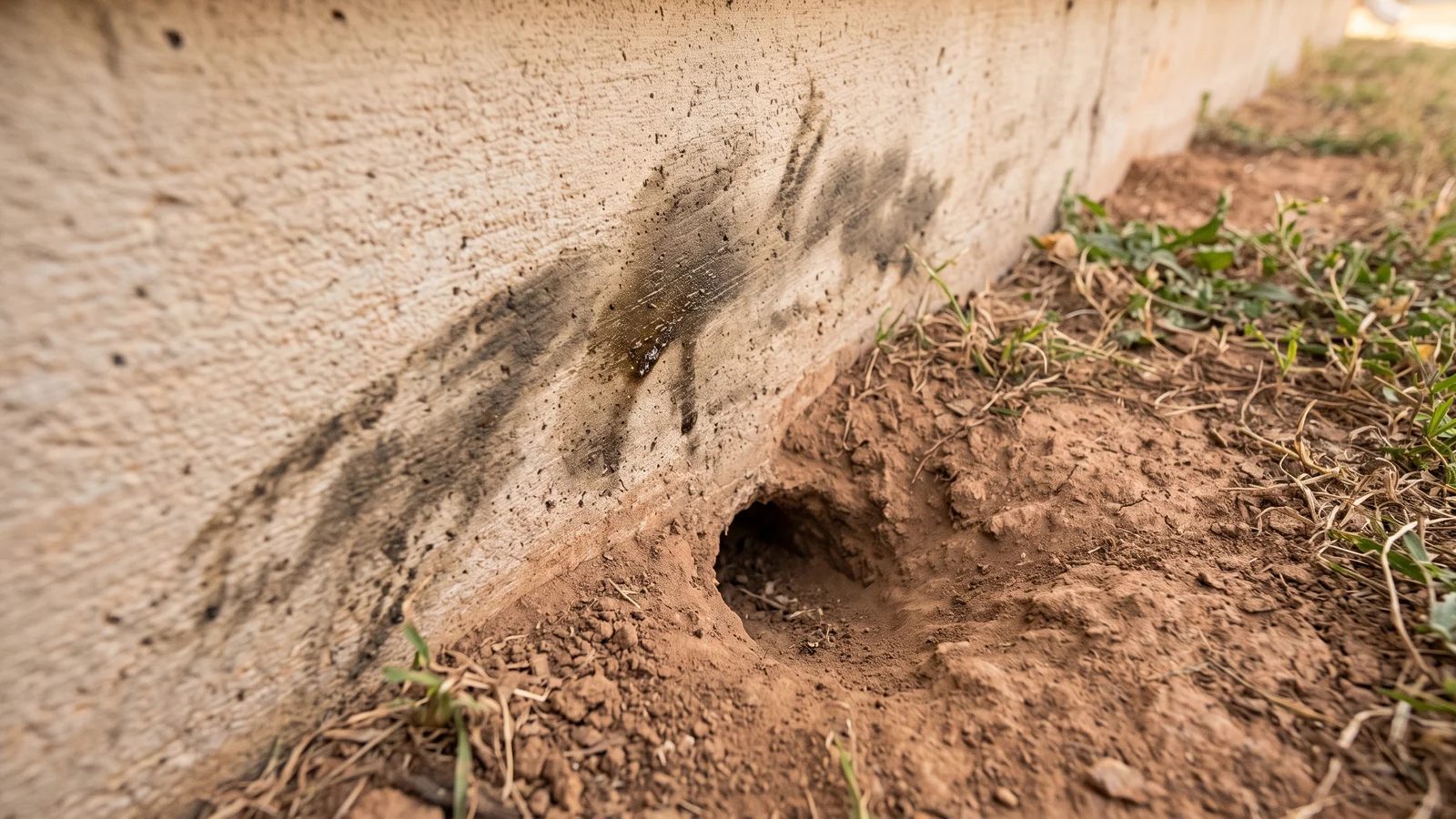
Norway rats dig burrows near foundations and woodpiles.
Rats leave heavier, more obvious signs than mice.
Dark, capsule-shaped droppings near food and walls.
Two-inch holes near foundations, decks, or debris.
Dark, oily smears along walls from repeated runs.
Rough chew marks on wood, pipes, and wiring.
Louder scurrying and thumps overhead point to roof rats.
Worn paths through grass or dust where rats travel.
Large, raisin-sized droppings mean rats, not mice.
Check foundations and yards for two-inch holes.
Roof rats nest in attics, Norway rats in the ground.
Book an inspection to map runs and entry points.
Rats are larger, stronger, and more destructive than mice. Their heavy gnawing damages wood, pipes, and electrical wiring, and chewed wires raise the risk of a house fire. A single burrow can also undermine slabs and walkways over time.
The health risk is greater too. Rats can spread bacteria and parasites through their droppings, urine, and bites, and they contaminate far more food than mice because they eat and store more. Their nesting fouls attics and crawlspaces.
Rats are also smart and wary of new objects, which makes them harder to trap than mice. A professional plan that combines exclusion, targeted control, and follow-up is usually needed to clear an established rat population for good.
Very knowledgeable. I have him handle pest issues at all of my houses. Quick to respond and gets it done right. Highly recommend.
We had rats in the attic and they cleared them out and sealed the gaps. Thorough and professional from start to finish.
He did an extra treatment on the first visit and came back after two weeks. The problem was gone in both houses. Very trustworthy.
Get a free inspection from a veteran-owned team. We confirm the rodent, map the runs and burrows, and seal your home across the Oklahoma City metro.